There is a lot of talk about a “democracy simulation,” election fraud, and manipulation by the media. But what do the facts about democracy actually look like?
Even the ancient Greeks were familiar with all the forms of government we know today. In our modern era, hardly anyone would likely perceive democracy as a form of government. But appearances may be deceiving.
Plato, a student of Socrates, described the cycle of forms of government as hierarchical stages. Before the French Revolution, there were still aristocracies, which were replaced by timocracies and then transformed into oligarchies. These subsequently gave way to the democracies we know today. What hardly anyone knows is that the ancient Greeks already described the next stage after democracy as tyranny.
So how can it be that a democracy performs so poorly?
If we examine the term a bit more closely, it breaks down into two parts.
In the ancient Greek context, “demos” refers to the smallest administrative unit—that is, a community or a village. The “demotes” are its members. Before the emergence of centralized forms of government, our modern society was composed of many small, decentralized villages.
The concept of the Dunbar number originates from this period. The Dunbar number refers to the theoretical cognitive limit on the number of people with whom an individual can maintain stable social relationships.
The term was coined by the British anthropologist Robin Dunbar, who, in the 1990s, identified a correlation between brain size (specifically that of the neocortex) in primates and the size of their social groups.
It is generally believed that this number may be around 300—the size of a small village where democracy can function well.
The suffix -cracy (often discussed as the standalone word “cracy” in the context of forms of government) comes directly from Ancient Greek. It can be interpreted as strength or power, and together these elements represent the capacity of a small village.
It is therefore obvious that a modern democracy encompassing hundreds of millions of people in a single state is open to question.
In this context, a party system is already a contradiction in terms. This is because political parties are prone to disruption and, especially with today’s media, offer ample room for manipulation. Direct, democratic elections are already impossible with political parties.
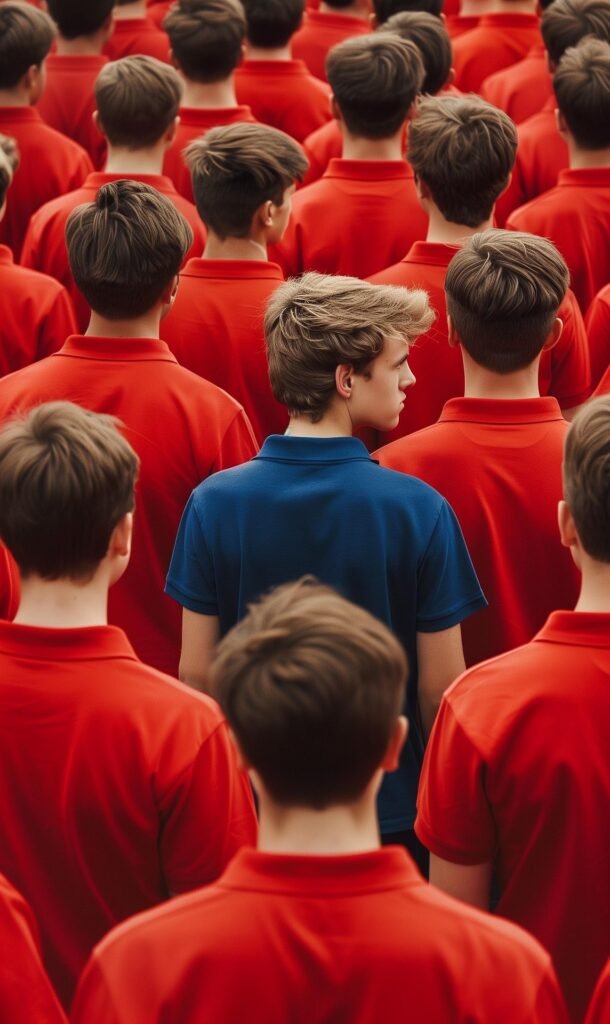
But the real problem lies in the nature of the matter itself. In a country with, say, 100 million inhabitants, there will be a dominant group after an election—for example, 60 million people. The outnumbered group of the remaining forty million people is then automatically and forcibly suppressed and must submit.
There is no way to simply move to another village or district if one wishes to remain loyal to one’s homeland and accept different social norms. If one refuses to submit to the laws of the majority, one is forced to leave the country entirely. Whether this can be called justice is certainly open to question. Manipulation through the media and politics—and above all, moralizing—are frequently observed tools that cast doubt on the nature of democracy. For if one considers the losing side of a party election to be legitimately suppressed, the path to tyranny is indeed not far off.
If we also take into account the formation of other hierarchies in this context—such as the European Union or central banks—the concept of democracy takes on even more questionable characteristics than appearances might suggest.