Anyone who takes a closer look at the precision of terminology will find that the German language is very precise in its phrasing. So what is right, and what is wrong? The article on the topic of the single, digital truth in the context of decentralization describes these characteristics in detail.
This also means that “right” and “wrong” must be clearly distinguished from, for example, “good” and “bad.” The latter depend on the perspective and are subjective perceptions.
But this is not the case with food. In the vast majority of cases, there are well-founded and neutral studies on what provides our bodies with the right nutrients and what provides the wrong ones.
For example, it has been clearly proven that carbohydrates are not essential nutrients for the human body. Here, too, please refer to the blog post on carbohydrates. So eliminating them entirely is not only not wrong but has verifiably, exclusively positive effects.
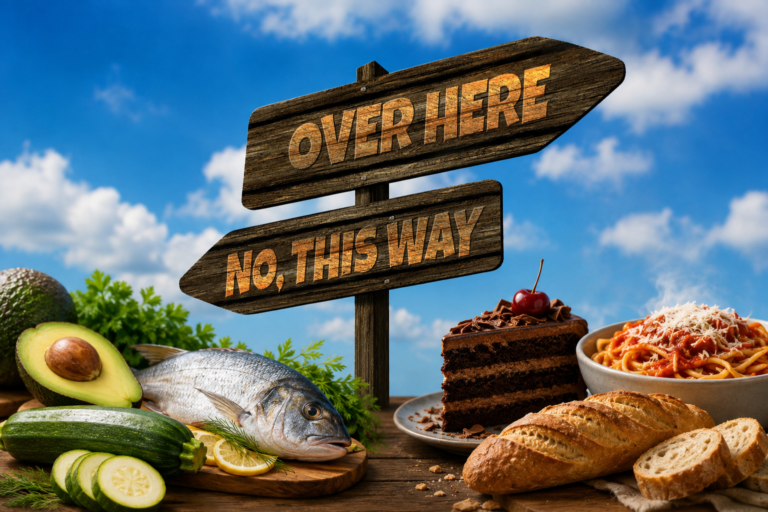
For many, this is a shock, since carbohydrates make up the vast majority of what’s found in our grocery stores. The food industry, however, calls them “staple foods.” Bread, pasta, potatoes, rice; even fruit and other starchy vegetables.
Even when we talk about organic foods, that doesn’t necessarily mean they’re healthy foods. After all, even organic sugar is a dangerous substance for the body. It’s found in abundance in almost all of the carbohydrate-rich foods mentioned earlier, especially in fruit. This is because, due to its nature, fructose can only be metabolized in the liver—and only in small amounts. Fructose is therefore by far the more problematic type of carbohydrate. In many cases, fruit is thus far from what many people consider to be good food.
Every carbohydrate is converted in the body, one-to-one, into glucose and fructose. One gram of carbohydrates equals one gram of sugar. For bread, for example, this is hard for many people to imagine. If the body cannot process these immediately, inflammatory processes can develop—the root cause of almost every known serious disease.
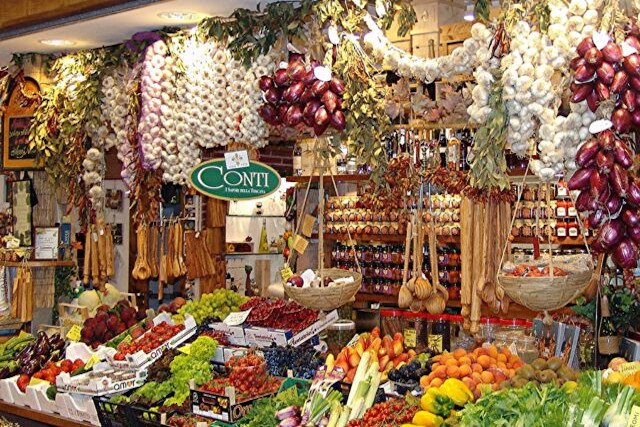
But the use of pesticides, growth hormones, or antibiotics also causes dangerous damage to the human body. This is another reason why there is hardly any real food left in supermarkets. And that is a sad reality. We live in a world where less than five percent of the items on most grocery store shelves are real food.
This is because processed foods are another extremely risky factor when it comes to eating a healthy and balanced diet. There is virtually no processed product that does not contain some highly undesirable ingredients from the pharmaceutical industry’s “chemical toolkit”—ingredients that, ideally, should not be consumed. The problem extends to seed oils and other unhealthy fats.
An ideal omega-6-to-omega-3 ratio is almost impossible to achieve today, given that the current ratio stands at about 25:1. The problem: An excess of omega-6 has also been proven to promote inflammatory processes in the body. Both fatty acids compete for the same metabolic pathways, which is why a balanced ratio is essential. In the early days of humanity, among hunter-gatherers, the ratio was 1:1, which reflects the ideal state.
These facts also answer the question of why, currently and especially in the future, the vast majority of people die from so-called lifestyle diseases rather than from natural causes. The question of “right” or “wrong” foods is therefore not a philosophical one; rather, it is a sad reality that the pharmaceutical industry is delighted to see perpetuated, but humans are not. The now-accepted notion that health problems automatically increase with age can therefore be considered a preventable misconception.
Numerous sources of reliable and unbiased studies can be found online. The book *Explosive Foods* contains the most important evidence in a concise form.