BLOG
Are there any similar crypto projects that are comparable to Bitcoin?
2026-10-01 – JeDI Consulting – reading time 4 minutes
The vast majority of crypto projects have turned out to be scams to one degree or another. In most cases, the only winners have been the project creators, at the expense of speculators.
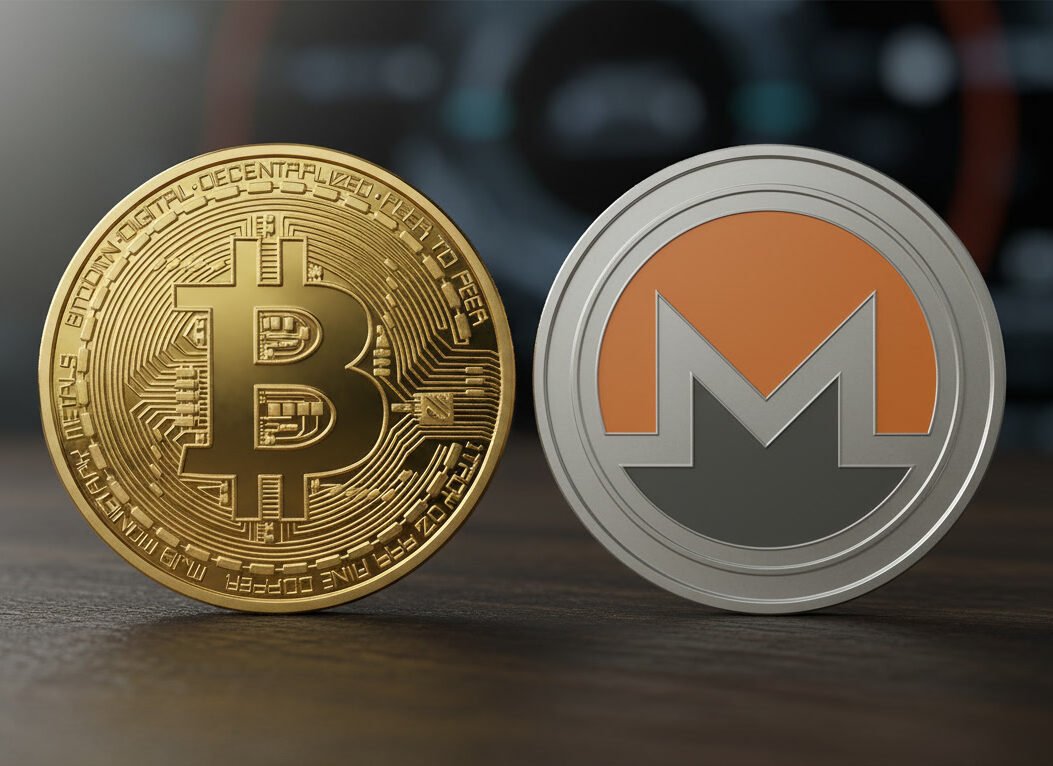
However, there is one project that shares similar characteristics with Bitcoin (BTC). This project will be analyzed in this article.
The Monero network (XMR) was launched in 2014 by predominantly anonymous developers and has been in operation ever since. XMR uses a separate CryptoNote protocol that is not based on the BTC protocol.
Both projects operate on the Proof of Work concept. They are thus implemented via blockchains that are synchronized on private nodes, both publicly and via TOR. Mining XMR requires significantly less computing power than mining BTC. While special ASIC chips are required for BTC mining, XMR can be mined using CPUs—for example, with graphics card chips via the RandomX algorithm. The difficulty level for XMR does not increase over time, as it does for BTC, but rather depends on the number of participants in the network.
Therefore, the block size can also be scaled within certain limits when mining XMR. This is determined by the median of the last 100 blocks and, based on that, can be doubled at most.
With XMR, the block reward decreased with each block. The limit was reached as early as 2022 and has remained constant at 0.6 XMR ever since. With Bitcoin, the block reward is halved every 4 years (halving) to prevent centralization of mining.
With Monero, therefore (unlike with BTC), new coins are constantly being created, which corresponds to an increase in the money supply. As a result, there is no natural scarcity of XMR. By 2040, there will be approximately 21 million XMR coins in the network, and this number will continue to rise. The characteristic tail emission is estimated at approximately 0.87% annually. Due to the estimated loss rate from lost coins, it is projected that a balance will be maintained in relation to newly mined XMR coins.
An XMR transaction takes place via RingCT, meaning it is ring-structured. It is always carried out within a group of transactions, which is why neither the sender nor the recipient can be identified.

Thus, multiple participants are grouped together for each transaction. This can broadly be compared to a CoinJoin (mixer) in the Bitcoin network; however, in Bitcoin this affects the UTXO itself, whereas in XMR it affects each individual transaction.
Only the owner of the private key has the ability to release a view key, which makes the transaction transparent. This is referred to as “optional transparency.”
A ring transaction requires significantly more data volume than a BTC transaction. As a result, the size of the XMR blockchain grows more rapidly. However, since the data volume for XMR is not yet comparable to that of BTC, this is not yet a major concern.
In the medium term, however, this could lead to centralization, which is avoided in the BTC network due to its deliberately small block size.
After more than 70 exchanges delisted XMR—including Binance in early 2024—Monero’s price plummeted from $165 to $125. By the fourth quarter of 2026, however, the price had risen back above $560.
The key issue with Monero/XMR, however, is that its decentralization has not yet been able to develop to a significant degree. Although it is also a proof-of-work network, XMR is mined using off-the-shelf chips, which could allow a potential (albeit very large) attacker to seriously harm the network. A large, global tech company could theoretically pool all of its computing power to cause a disruption without having to invest in specialized hardware. Whether this would be realistic remains questionable.
Bitcoin’s decentralization has already grown to such an extent that even an entire country like the U.S. would not be able to cause a disruption in the network.
| XMR - Monero | BTC - Bitcoin |
|---|---|
| Trade is more difficult, but legal | Widely accepted |
| Anonymous Ring Transactions | P2P Transactions (Pseudonymous) |
| Continuous Coin Growth | Coin limit set at 21 million |
| Variable block size | 1 MB (max. 4 MB) limit |
| Mining: Graphics CPU | Mining: ASIC Chips |
| Adjusting Difficulty per Block | Adjust difficulty every 2 weeks |
| Block generation: 2 minutes | Block generation: 10 minutes |
| Block Reward: a constant 0.6 XMR | Disinflationary/deflationary due to the halving |
| Approx. 20,000 nodes | An estimated several hundred thousand nodes |
Comparison of Market Capitalizations at the Start of Q4 2026
XMR (price approx. $560)
approx. $10 billion
BTC (price approx. $83,000)
approx. $1.5 trillion
Gold (price per troy ounce approx. $4,200)
approx. $29 trillion
XAU/BTC ratio:
approx. 20 troy ounces of gold per Bitcoin